Understanding real-world Wi-Fi throughput
There are two facts we can't ignore:
-
Internet Service Providers (ISPs) have increased their speed offerings to consumers.
-
Consumers’ expectations have increased dramatically when it comes to their Wi-Fi experience.
Almost every major networking equipment manufacturer has a product that boasts phenomenal Wi-Fi speeds: “1200 Mbps,” “1750 Mbps,” or “come here for 2600 Mbps!” But when the integrator sells those Wi-Fi speeds to the consumer, reality hits after deployment. Speeds are not near what has been advertised, dead spots still exist, and buffering is the kiss of death when the consumer paid for full-gigabyte service from the ISP.
Networking equipment manufacturers (ourselves included) have fallen into what we call "the numbers game." Let's take a 3×3 Wireless AC access point, for example:
The advertised speed for this product is 1750 Mbps. Pretty great when you have 450 Mbps coming from the ISP, right? Before you get excited, let's break down how manufacturers got the 1750 Mbps number. The math is simple: we have 3 streams on 2.4 GHz and 3 streams on 5 GHz radio interfaces. Per 802.11ac standards, on 2.4 GHz radio, when a device establishes a connection with the access point using 40 MHz channel bonding (MCS7), then the stream maximum throughput is 150 Mbps. We have 3 streams on 2.4 GHz, so this equals 450 Mbps on the 2.4 GHz radio. Similarly (again per 802.11ac standard), when a device establishes a connection with the access point using a 5 GHz radio and 80 MHz channel bonding (MCS9), then the stream maximum throughput is 433.3 Mbps (5 GHz has more throughput than 2.4 GHz). We have 3 streams on 5 GHz, as well, so this equals 1300 Mbps on 5 GHz. Now, since the access point is dual-band concurrent, combine the maximum speeds on both interfaces and voila! We have 450 Mbps + 1300 Mbps = 1750 Mbps!
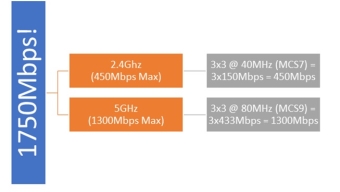
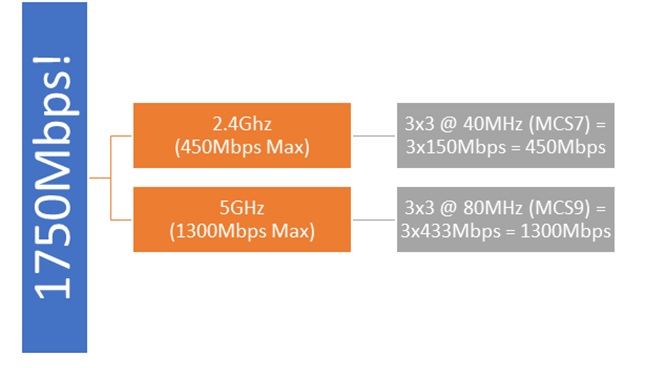
Because that graphic makes it much simpler to understand…
The main problem with this math—while technically correct—is that it's not realistic.
So, what is realistic?
Starting with 2.4 GHz interface, since the spectrum is very congested and the number of non-overlapping channels on the 2.4 GHz spectrum is limited to 3 channels, each of which is 20 MHz wide, there are no devices that negotiate 40 MHz channel bonding on 2.4 GHz. The probability of frame retransmits is very high when using 40 MHz on a 2.4 GHz radio due to noise or interference. So, achieving 40 MHz channel bonding on 2.4 GHz—while technically possible and tested in labs—is virtually impossible in real life. Devices opt for 20 MHz channel bonding only, which results in the case of 3 streams to a maximum of 195 Mbps (remember it was 450 Mbps in the ideal state).In addition, Wi-Fi as a technology is a shared medium. In other words, it's a half-duplex medium. Only one device can talk at any one point in time: either the access point to a client device or a client device to the access point. This means the maximum 195 Mbps is effectively a maximum of 97 Mbps realized by the client device (it must listen half of the time, assuming no one else is “talking” to the access point).
The fun doesn't stop here—this 97 Mbps assumes the wireless medium is used 100% of time to transmit content (for example, a YouTube video stream), but that's not the case. Since it's a shared medium, Wi-Fi is notorious for having management traffic overhead in order to control who is talking at one point of time and who gets to talk next. This management overhead increases dramatically by three factors:
-
Number of SSIDs advertised on an access point
-
Number of access points in the location
-
Number of Wi-Fi devices in the location
The more of these three factors, the more coordination and management messages need to be sent, occupying valuable airtime that could be used to transmit actual traffic. Also, interference causes faulty frames to be received, which triggers retransmits and slows down mechanisms, lowering the effective throughput.
In addition, the maximum throughput assumes you have a clear line of sight and a very little distance between the device and the access point. The further the client device moves away from the access point, the weaker you’re the signal, and the lower the throughput. The same logic and limitations go to 5 GHz radio.
So, what does that mean to the effective real-life throughput? In order to answer that, we have to flip the perspective of the above figure to be from the client device trying to connect to an access point. All the aspects listed below dramatically affect the throughput of the device:
-
Radio Interface: Big difference between 2.4 GHz and 5 GHz from a nominal speed perspective.
-
Number of streams: It's a two-way street between the device and the access point. Most mobile devices have two streams only.
-
Channel Bonding: If the radio interface is 2.4 GHz, 20 MHz is the realistic channel bandwidth. If 5 GHz, we start with 80 MHz but can automatically fall back to 40 MHz if the environment is noisy.
-
Half-Duplex Nature: By design, Wi-Fi is half duplex, so whatever the maximum negotiated throughput, it's cut in half because of this.
-
Wi-Fi Overhead: The more access points and SSIDs at a location, the less effective the wireless medium is.
-
Wireless Contention: The more Wi-Fi devices trying to connect to an access point, the longer a certain device waits before it gets a chance to talk.
-
Distance from the AP: Also known as signal strength, which degrades naturally with distance as well as obstacles near the location.
-
Interference: All sources of interference severely affect the effective throughput.
-
Legacy Devices: Because of the half-duplex nature, if there is an old device talking at 54 Mbps on the network, all other devices will wait longer for the old device to finish talking.
-
TCP Acknowledgements: If the connection is TCP, it adds a lot of overhead to the medium because every packet needs to be acknowledged by the receiver.
-
Retransmits: If one bit of a frame is corrupted due to collision, the entire frame needs to be retransmitted.
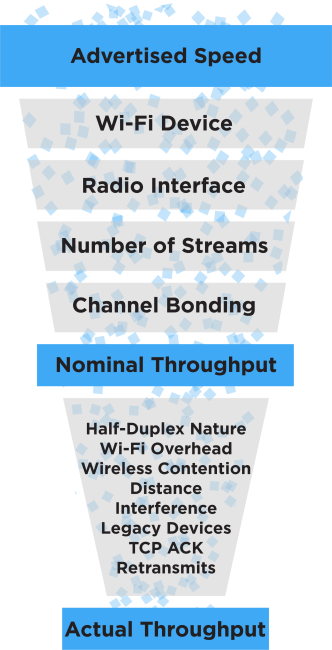
These factors subtract from the nominal throughput and vary widely by each location or time frame. This results in rules-of-thumb throughput figures rather than concrete numbers (more of an average than a measurement). We find that a good 2.4 GHz environment provides an effective throughput between 20 Mbps-40 Mbps, while a good 5 GHz environment provides 150 Mbps-400 Mbps effective throughput. These are big deltas from the advertised maximum theoretical numbers by networking equipment manufacturers, which are, again, technically not wrong.
So, the next time a customer asks you, “I just signed up for 300 Mbps internet; will I get 300 Mbps across the house via Wi-Fi?" The answer is: technically yes, but realistically not likely.